Living Room
10 Curved Furniture & Arch Decor Ideas for Softer Rooms
10 curved furniture ideas for softer, calmer rooms: curved sofas, barrel chairs, arched mirrors, round tables and arch details that warm up boxy spaces.
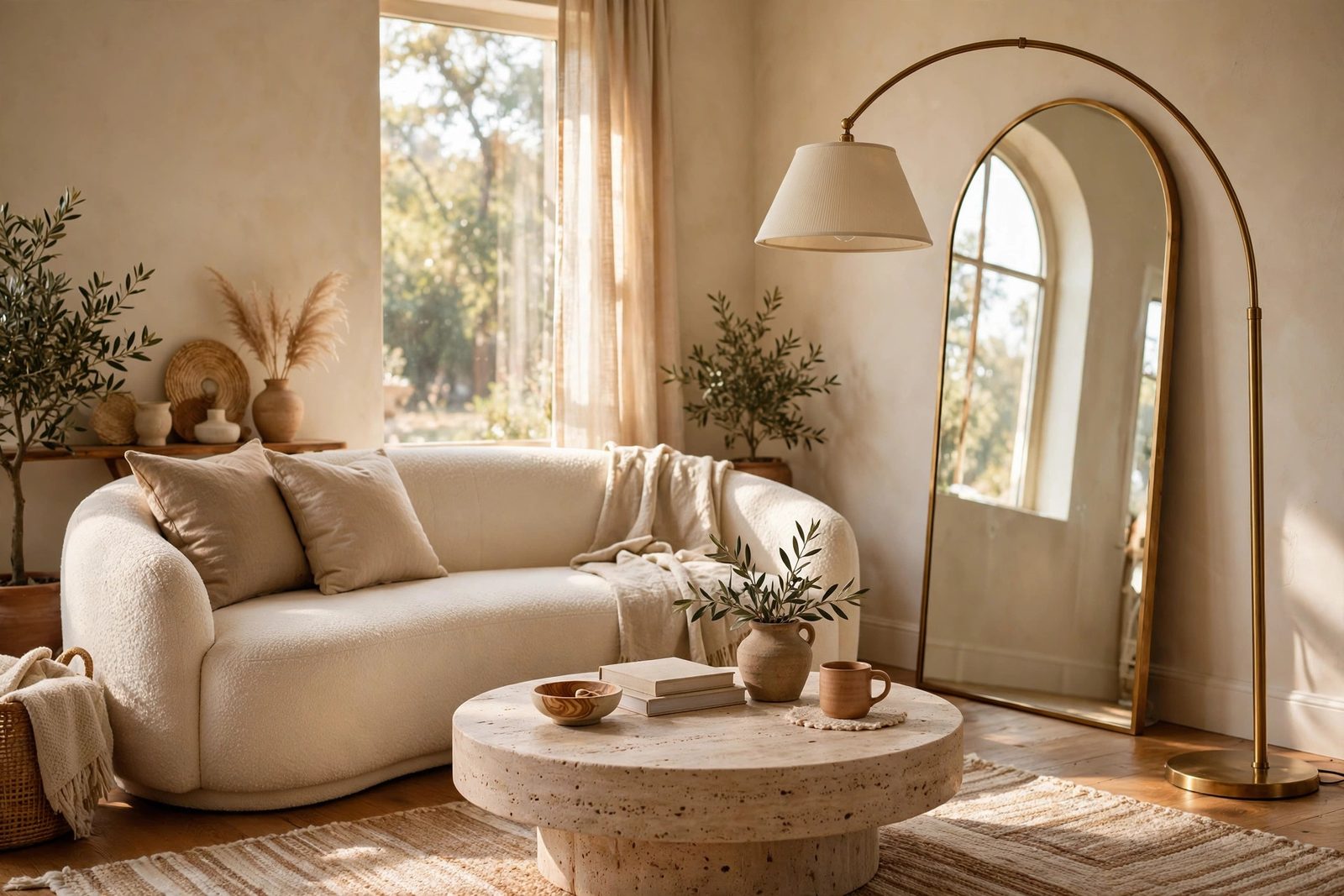
The 2027 forecast reports are unanimous on one point: curved furniture ideas are officially replacing the boxy, sharp-edged rooms of the last decade. Rounded sofas, arched mirrors, barrel chairs and crescent-shaped tables are showing up in every trend roundup, and for good reason — soft shapes make rooms feel calmer, more welcoming and far more interesting than another straight-lined sectional.
There is real psychology behind it. Sharp corners read as tension; curves read as comfort. A room full of right angles can look perfectly styled and still feel cold, while one curved sofa or arched mirror breaks the grid and makes the whole space exhale. You do not need to gut the room or buy a full matching set to get there — one well-chosen curve can change the energy.
Below are ten practical ways to bring curves and arches into your home, from a curved loveseat in a reading corner to a painted arch nook that costs almost nothing. Every idea works with the straight-lined furniture you already own.
What Is the Easiest Way to Add Curved Furniture to a Living Room?
Start with the sofa. A curved cream boucle sofa is the single most impactful swap in a living room because it is the largest shape in the room, and softening it changes everything around it. The gentle arc of the back pulls the eye along a curve instead of a corner, and boucle's nubby texture makes the softness literal — you can see and feel it.
Let the sofa set the geometry for the rest of the arrangement. Place a round coffee table in front of it rather than a rectangle: the matching curves echo each other and keep walkways open on the sides, which matters in real living rooms. An arched floor lamp behind one corner mirrors the sofa's arc from above, and an arched full-length mirror leaning nearby doubles both the light and the curves.
Keep the rest of the room's lines quiet. If your media console and bookshelves are straight-edged, that is fine — one curved anchor, one round table and two arch accents are enough to soften the room without asking you to replace everything. The contrast is actually what makes the curves stand out.
How Do You Style a Curved Loveseat in a Reading Corner?
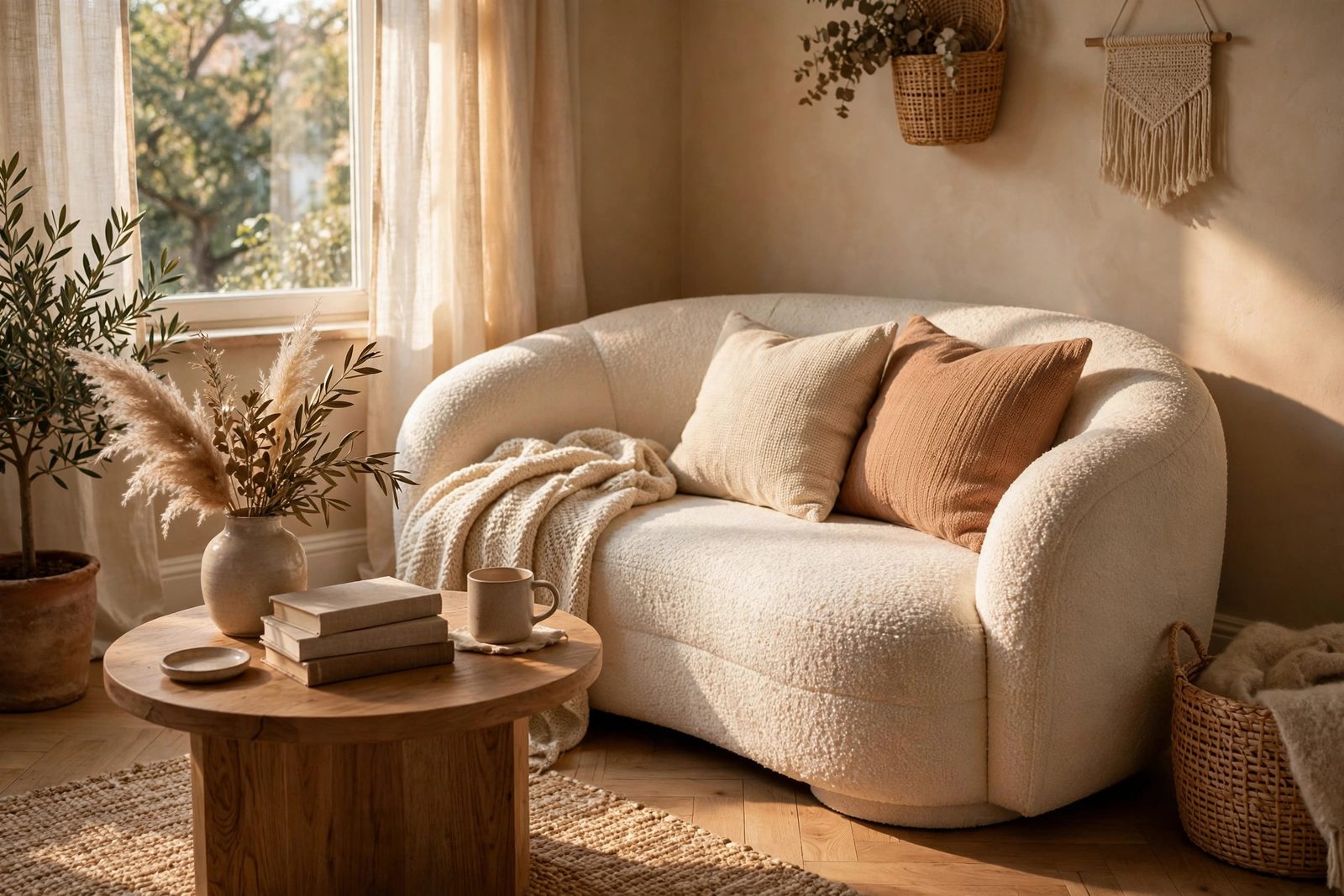
A curved loveseat is the reading corner's best friend. Its inward arc naturally wraps around whoever sits in it, which is exactly the cradled feeling you want for long chapters, and it turns to face the room at an angle instead of sitting parallel to the wall like a straight bench. That slight rotation makes even a forgotten corner feel like a destination.
Pair it with a round wooden side table, not a square one. A small round table tucks into the curve's inner corner without wasted gaps, and its top is exactly where a mug and a book want to live — within arm's reach from any spot on the loveseat. Choose a wood tone that echoes something else nearby, like your flooring or a picture frame, so the corner feels tied into the room.
Finish with a floor lamp that has an arched or dome shade and a small round rug underfoot. The lamp gives you reading light that flatters the curve instead of fighting it, and the rug anchors the corner so it reads as its own little room-within-a-room rather than furniture pushed against a wall.
Do Arched Mirrors Really Make a Room Feel Softer?
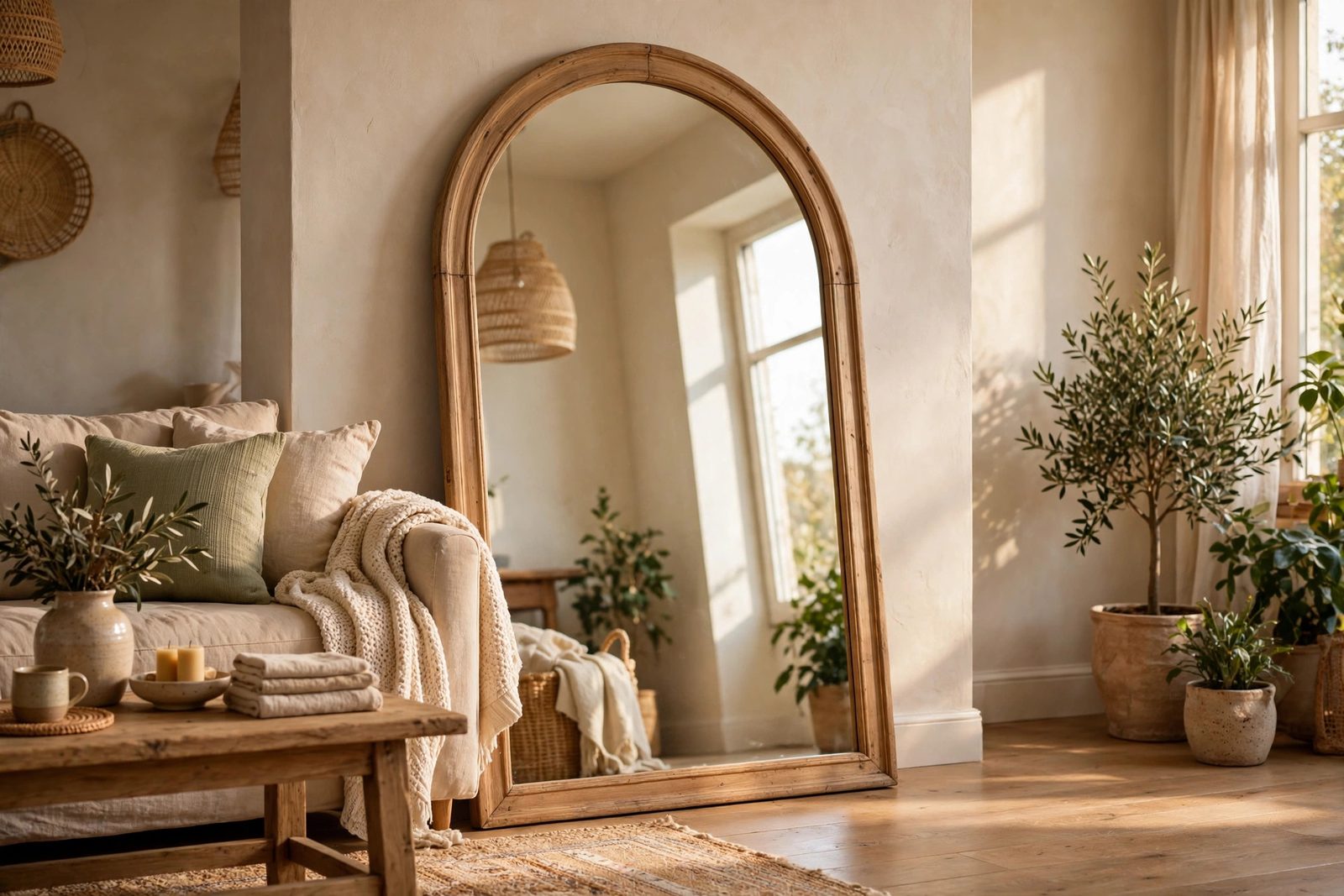
Yes, and it is one of the cheapest ways to test the trend. An oversized arched full-length mirror leaning against a wall introduces an arch into the room's sightlines without touching the architecture. The curved top breaks up the usual grid of rectangular frames, windows and doorways, and because it is a mirror, it multiplies the effect by reflecting the room's softest light back at you.
Lean it, don't hang it — at least at first. A full-length arch mirror leaned at a slight angle against the wall feels casual and sculptural, and you can move it around to find the spot where it catches the most daylight. Once you love the placement, secure the top with a small anti-tip bracket so it is safe around kids, pets and clumsy evenings.
Style the wall around it simply. The mirror is the statement, so resist the urge to flank it with a busy gallery wall. One leaning arch mirror with a small plant or a round pouf at its base is a complete vignette — anything more competes with the shape that is doing all the work.
How Do You Style a Round Coffee Table?
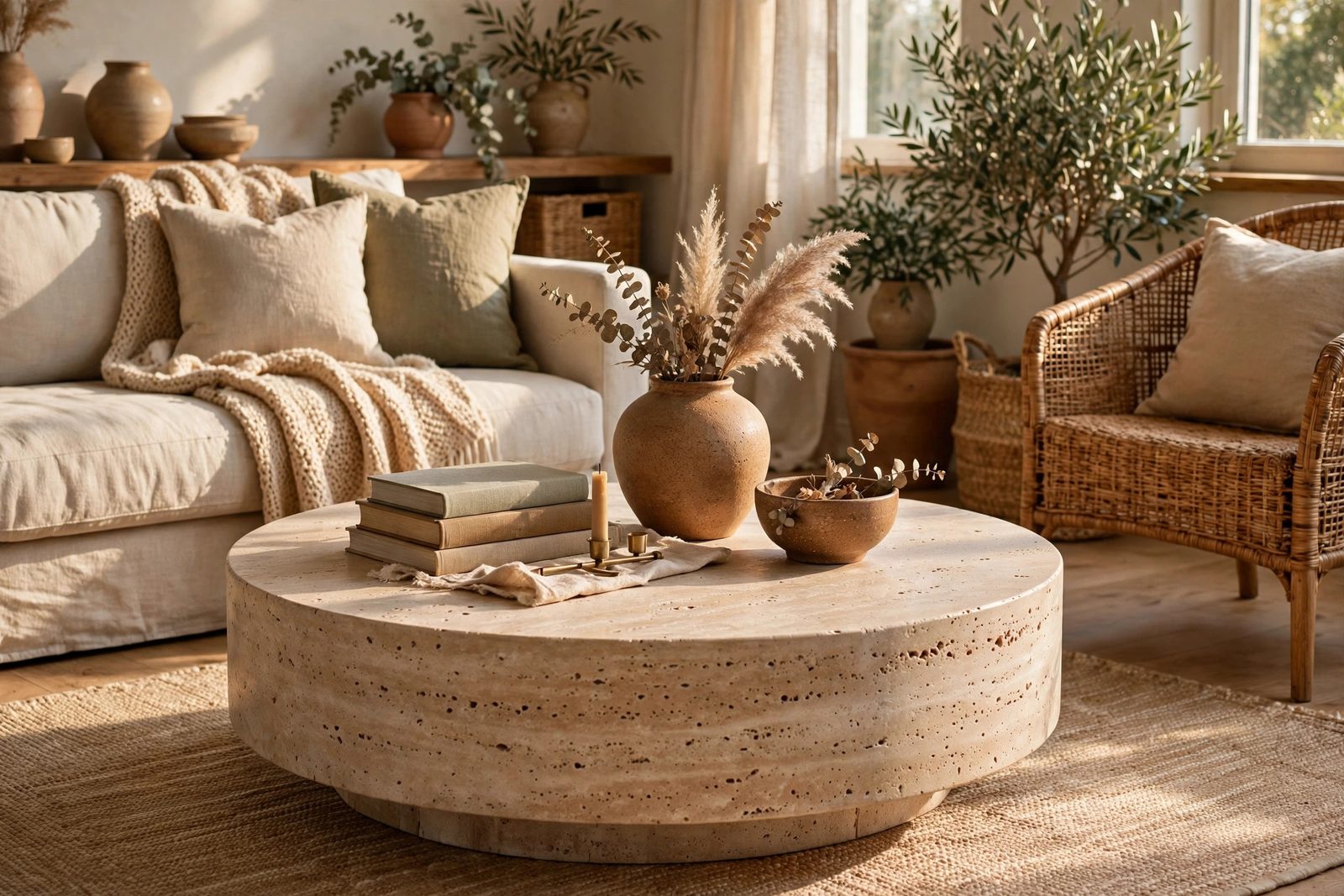
A round travertine coffee table is the hardest-working piece in a curves-forward living room: it echoes a curved sofa, softens the room's center, and its stone surface adds the kind of organic texture that flat-pack furniture can't. Style it in three zones rather than scattering things everywhere — a stack of two or three books, a ceramic vase with stems, and one small object like a candle or a sculptural bowl.
Height variation is the styling rule that matters most on a round surface. The vase gives you height, the books give you a low platform to lift the small object, and the negative space between the zones lets the travertine itself show — which is the point, since the stone's veining is half the decoration. Keep everything inside the table's edge; a round table has no corners to catch overhang, so pull items toward the center.
Choose stems with movement for the vase — eucalyptus, dried grasses or a few long branches — so the arrangement continues the curved language above the table. Straight, spiky arrangements fight the table's softness; soft, arching stems complete it.
Are Curved Barrel Chairs Worth It?
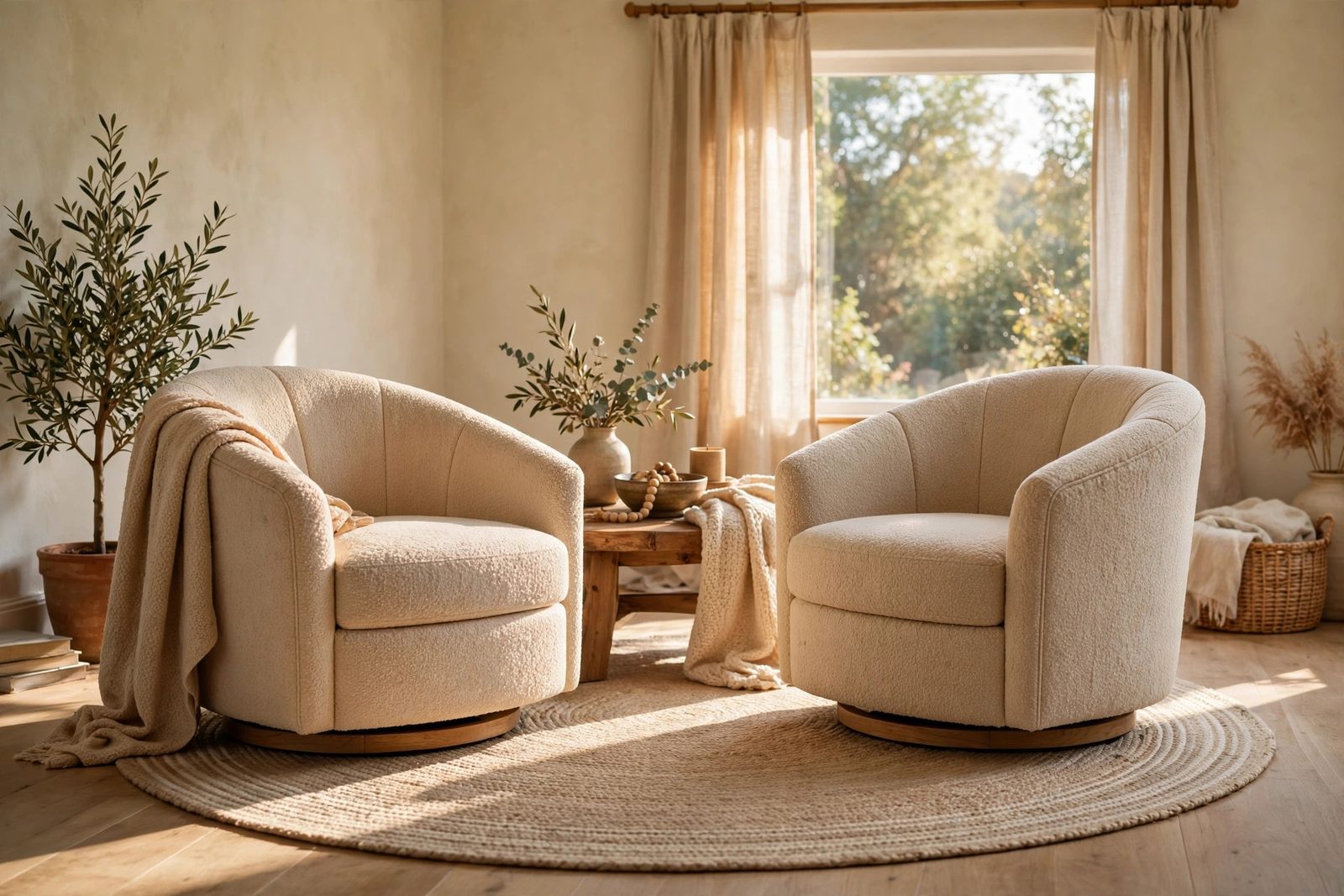
If you buy one curved accent piece, make it a pair of barrel chairs — or at least one. Their wraparound back is the most literal curve you can put in a room, and two of them angled toward each other around a round rug create an instant conversation zone that a pair of straight armchairs never quite manages. The curve physically turns people toward each other.
Swivel bases are worth the upgrade. A barrel chair that swivels lets the sitter face the conversation, then rotate toward the window or the TV without dragging furniture across the rug. In an open-plan room, swivel chairs are also how you make one seating area serve two purposes without rearranging anything.
Place them on a round rug that is large enough for both front legs to sit fully on it — that is the anchoring rule that keeps the pair from looking like they drifted apart. Leave a few inches of breathing room between the chairs and the rug's edge so the circle reads as intentional, not tight.
How Do You Add an Arch Without Renovating?
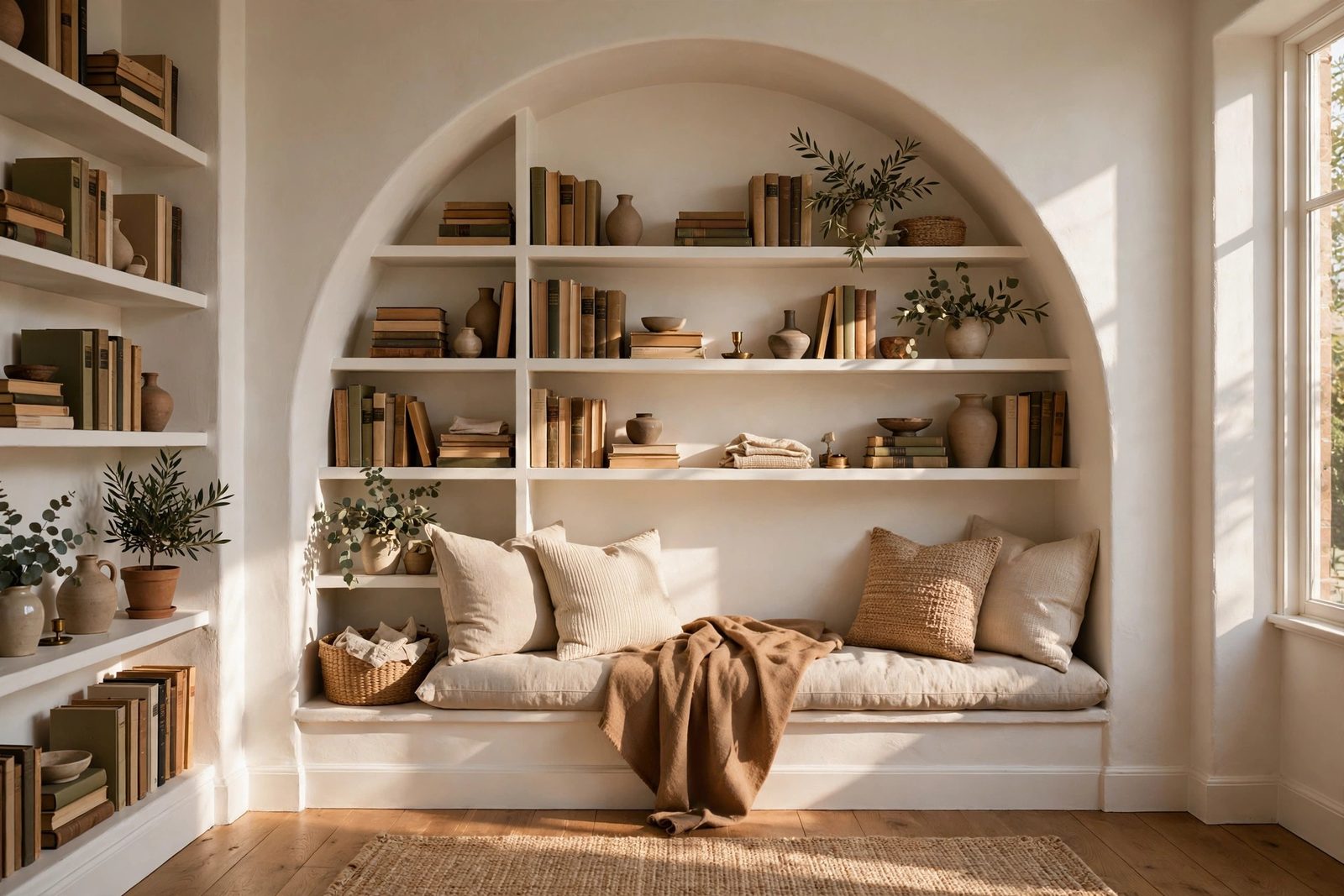
You do not need to cut a single stud to get an arch. A painted arch — a curved-top shape in warm white or a soft contrast color, painted directly on the wall behind a bookshelf, a desk or a reading chair — delivers the architectural feeling for the cost of a sample pot. Trace the curve with a pencil tied to a string anchored at the arch's center point, and you will get a perfect arc without any artistic talent.
Let the arch frame something you already own. A standard rectangular bookshelf sitting inside a painted arch suddenly reads as a built-in nook; a plain desk under an arch becomes a deliberate study zone. The painted curve does the architectural work, and your existing furniture provides the function.
Keep the arch color close to the wall color for a soft, tonal look — warm white on white, or a slightly deeper cream on beige — rather than a high-contrast color block. Tonal arches feel like architecture; bold contrast arches feel like a mural. Both are valid, but tonal is the safer first experiment, and it plays better with resale and renters.
What Is a Kidney-Shaped Side Table Good For?
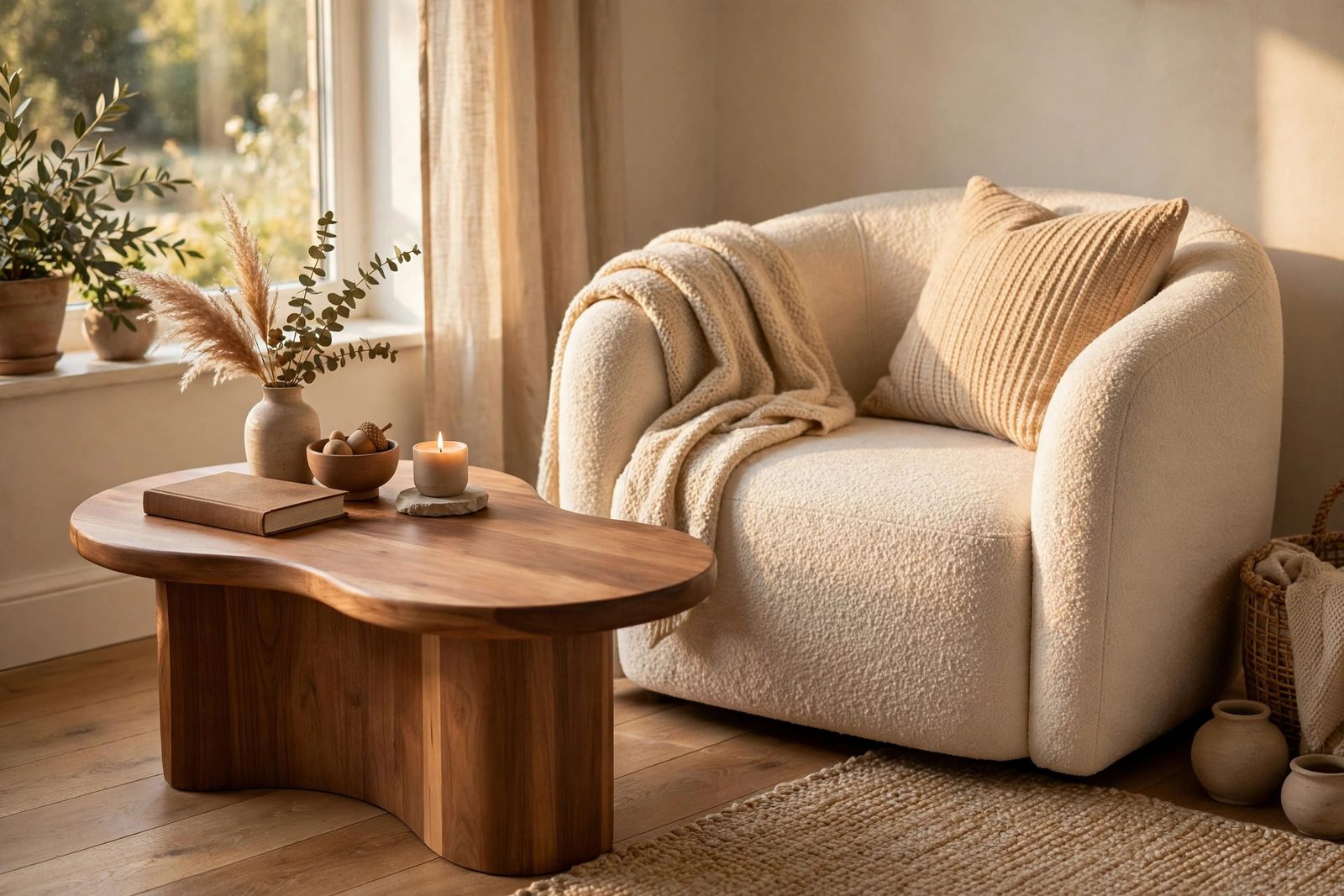
A kidney-shaped side table is the curve trend in its most practical form. The bean-like shape tucks its narrow end beside a chair and flares out where you need surface, which means it fits into the dead space next to a curved armchair better than any rectangle — no bumped shins, no awkward gap, no wasted corner.
It is also a shape-matcher. Place it next to a curved armchair and the two curves talk to each other: the table's organic outline echoes the chair's rounded back, and the pairing looks considered even when the wood and the upholstery are completely different. That is the whole secret of the trend — repeated soft shapes, not matched sets.
Style it with one thing, not five. A kidney table is small by design, and clutter defeats its elegance. One lamp with a rounded shade, one small stack of books, or one sculptural object — and leave the rest of the surface clear so the shape itself stays visible.
How Do You Mix a Velvet Accent Chair Into a Neutral Room?
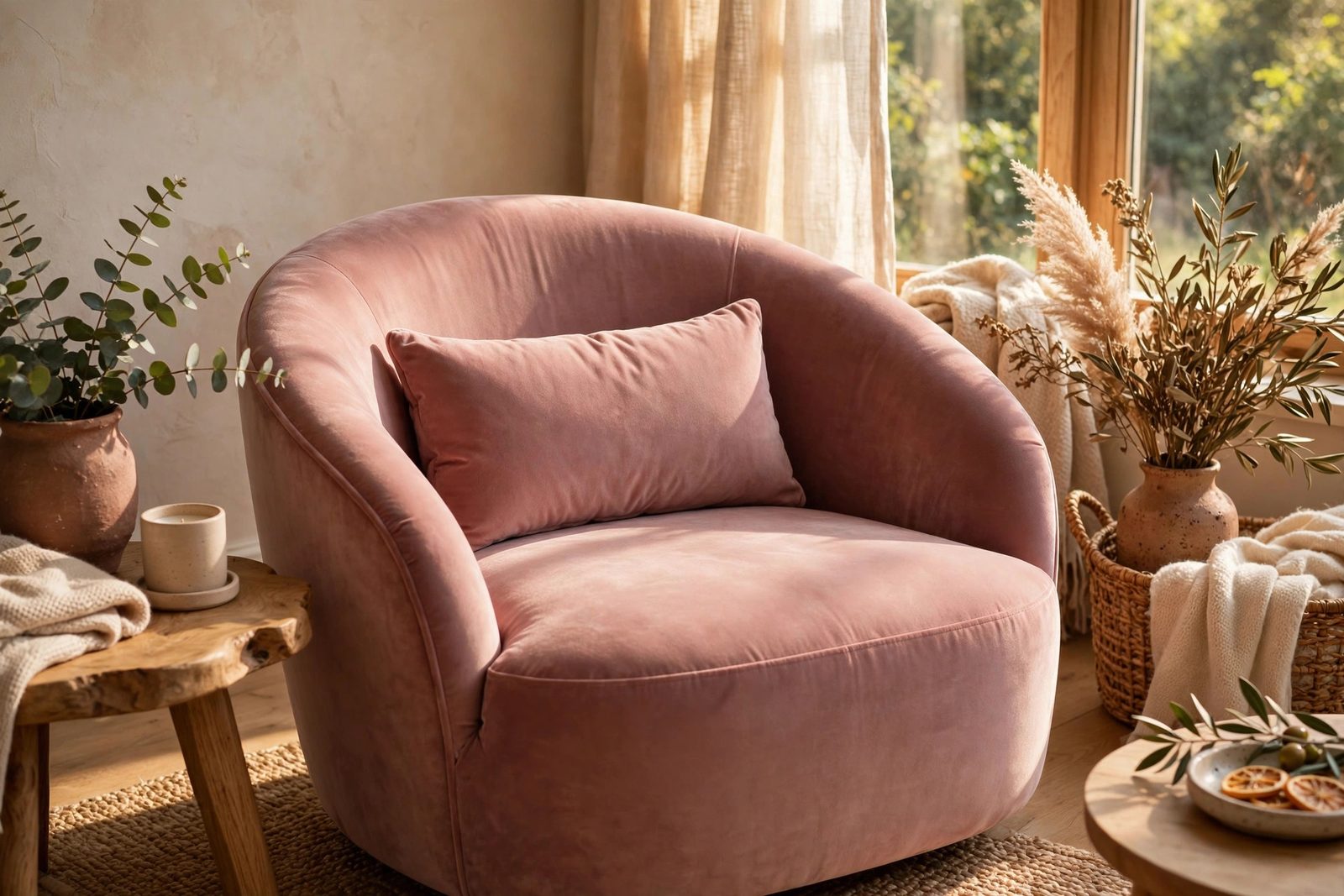
A curved velvet armchair in a dusty, muted tone — dusty rose, sage, warm taupe — is the lowest-commitment way to join the trend. The curve gives you the shape, the velvet gives you the softness, and the muted color keeps it from hijacking a neutral room. It reads as an accent, not a statement, which is exactly what you want for a first curved piece.
Give it a lumbar pillow in a contrasting texture, not a matching one. Velvet against boucle, or velvet against nubby linen, is what makes the chair look styled rather than showroom-new. The pillow also breaks up the chair's single-color expanse so the eye reads the curve first and the color second.
Float it at an angle instead of pushing it flat against the wall. A curved chair turned slightly into the room shows off its silhouette — the back is the best-looking part — and the angle makes it part of the seating conversation instead of a wallflower. Even six inches of rotation changes how the whole corner feels.
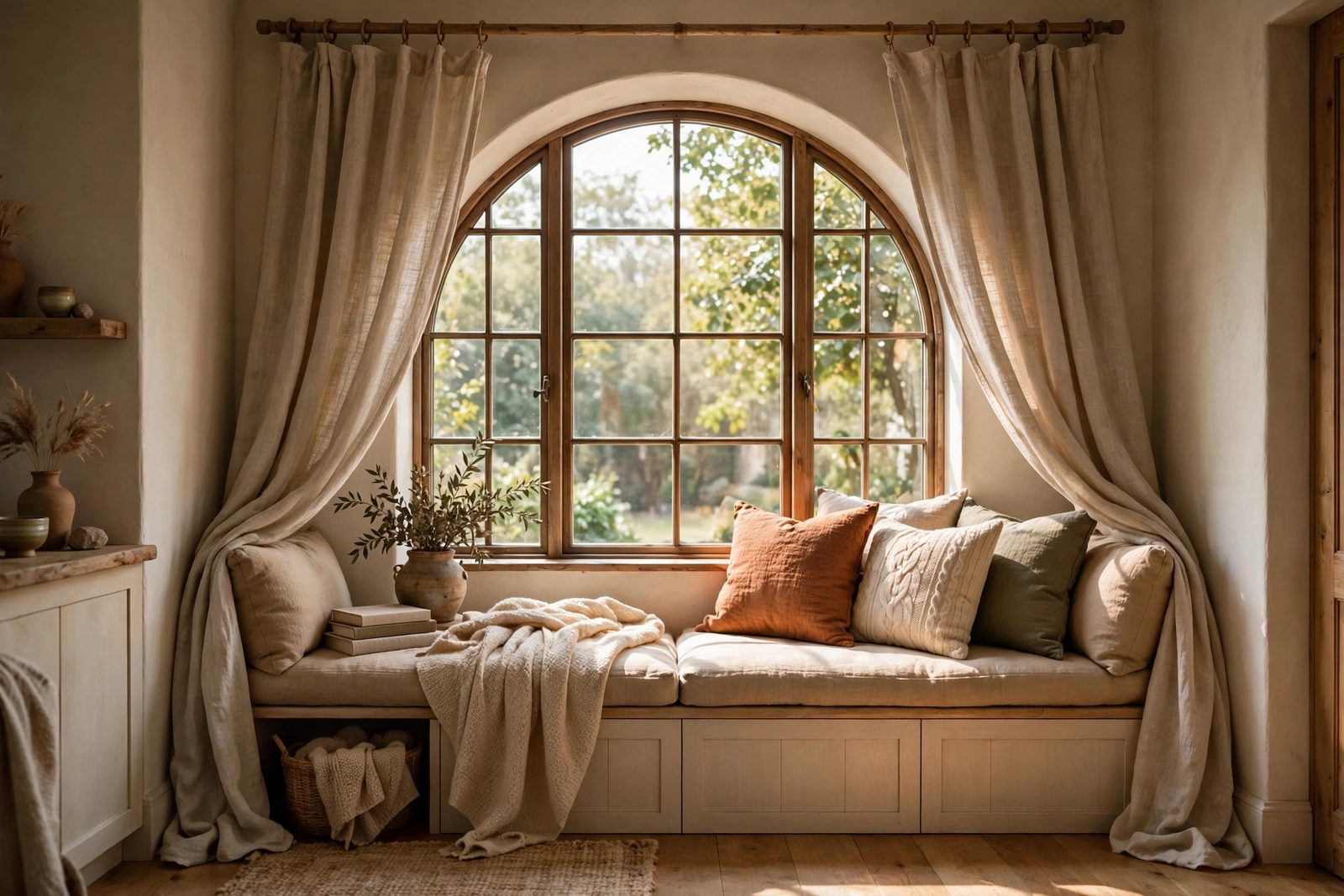
How Do You Dress an Arched Window?
If you are lucky enough to have an arched window, the number-one rule is: do not hide the arch. Hang your linen drapery on a straight rod mounted at the point where the arch begins to curve — or just above the window's widest point — and let the arched top stay fully exposed. Covering the curve with fabric defeats the entire reason the window is beautiful.
Linen is the right fabric here because its soft drape echoes the window's softness. Hang the panels wide, well past the window's edges, so that when they are open they frame the arch like a picture frame instead of nibbling at it. A slim, unobtrusive rod keeps the attention on the architecture, not the hardware.
Build the window seat beneath it as the payoff. A simple cushion, two pillows and a folded throw turn the wall under an arched window into the most coveted seat in the house — and the arch above it makes the nook feel intentional, like the house was designed around your reading habit. Add a small round side table and the curve story is complete.
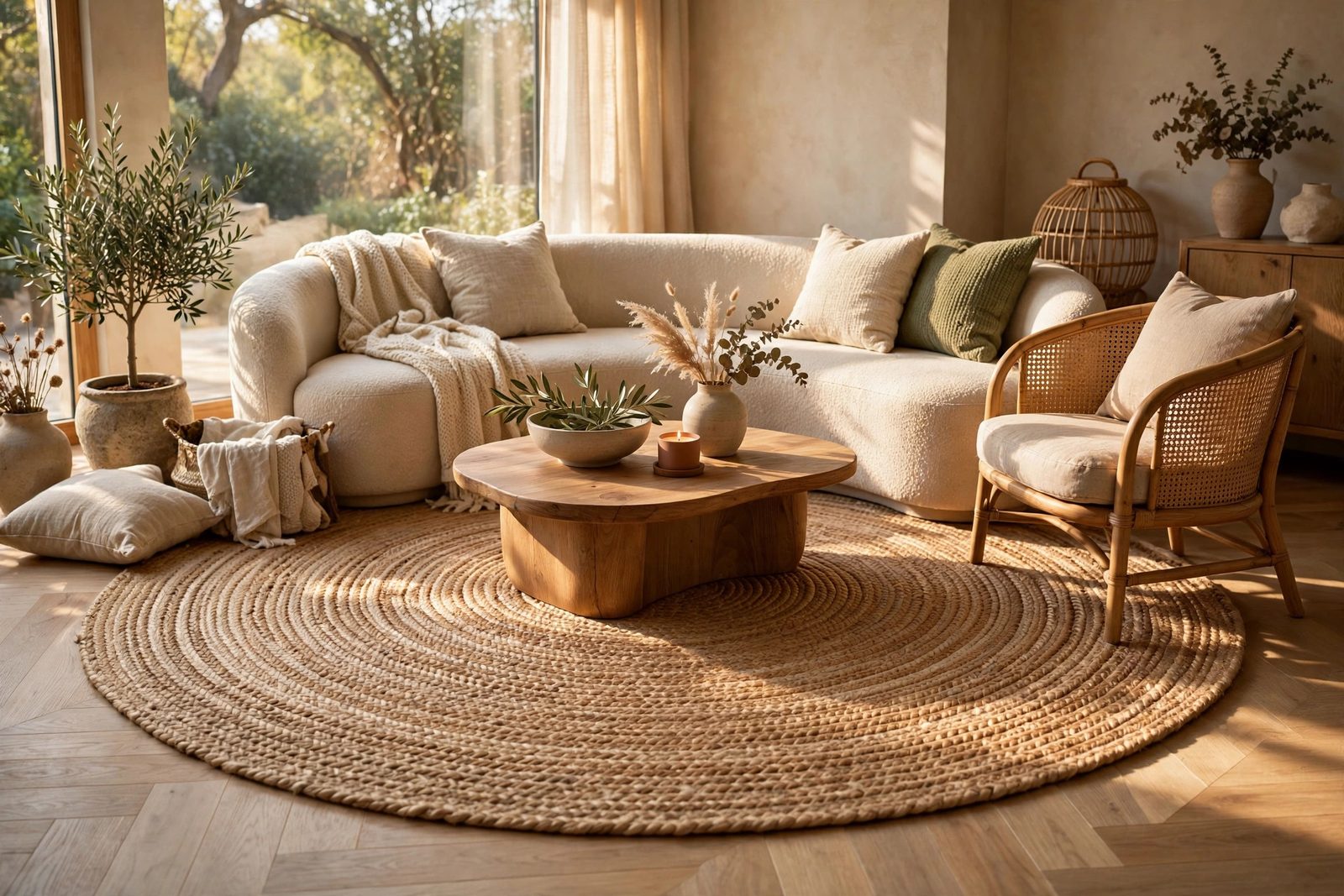
Why Does a Round Rug Work Best With Curved Furniture?
A round rug under a curved furniture arrangement does what a rectangle can't: it follows the furniture's geometry instead of fighting it. A rectangular rug under a curved sofa leaves awkward triangular gaps at the arc; a round rug's edge runs parallel to the curve, and the whole arrangement reads as one intentional shape. Jute is the ideal material because its natural texture keeps the look grounded and casual.
Size it generously. The front legs of every major piece — sofa, chairs, coffee table — should sit fully on the rug, with several inches of rug visible beyond them. An undersized round rug looks like a coaster under furniture; a properly sized one is the foundation the curves sit on.
Layer if you want more softness. A flat round jute rug with a smaller, plusher round rug centered on top gives you texture contrast and a defined zone for the coffee table — and it is an easy way to add pattern or color without committing to a large patterned rug. Keep the top layer simple so the layering reads as texture, not clutter.
Mixing Curves With the Straight-Lined Furniture You Already Own
You do not need to replace your straight-edged sofa, media console or bookshelves to join this trend — and you shouldn't. The most stylish curved rooms are mixed rooms, where one or two soft shapes stand out precisely because everything around them is straight. The contrast is the design.
Use the 80/20 rule as a starting point: let roughly 80 percent of your room keep its existing lines, and introduce curves in the remaining 20 percent through one anchor piece (a curved sofa or loveseat), one round surface (coffee table or rug) and one arch accent (mirror or painted arch). That ratio softens the room without making it feel like a furniture showroom theme.
Repeat the curve at least three times so it looks deliberate. A single round mirror in a room of rectangles can look like an accident; a round mirror plus a round coffee table plus an arched lamp reads as a choice. Echo the same curve language — arch with arch, circle with circle — and the mixed room pulls together fast.
Small-Room Rules for Curved Furniture
Curved furniture is genuinely good news for small rooms, because curves have no corners to bump into and round tables improve traffic flow around tight seating. A small curved loveseat angled into a corner often fits better than a straight loveseat pushed flat, since the angled placement uses the corner's depth instead of fighting it.
Scale down, don't skip. Choose apartment-scale curves — a petite barrel chair instead of an oversized one, a 36-inch round coffee table instead of 48 — and keep the room's biggest straight piece (usually the sofa or the media console) as the anchor. One correctly scaled curve beats three cramped ones.
Watch the walkways. Curves project into space differently than rectangles, so leave at least 30 inches of clear passage around a curved arrangement. If a curved piece forces you to squeeze past it, it is too big for the spot — move it, don't suffer it. Soft rooms should feel easy to move through, not like an obstacle course.
Final thoughts
The curve trend endures because it is not really about furniture — it is about how a room makes you feel. Sharp, boxy rooms can be beautiful and still feel tense; soft shapes invite you to exhale, sit down and stay a while. That is a feeling worth designing for, whether you go all in with a curved sofa or start with a single arched mirror.
Start small and live with it. Lean an arch mirror against the wall for a week, or swap in a round side table, and notice how the room's energy shifts before you commit to bigger pieces. Curves are forgiving that way — even one is enough to soften the whole space.
However far you take it, keep the mix. The prettiest curved rooms are the ones where soft shapes and straight lines share the space, each making the other look better. That balance is the whole idea — and it is what will keep your room feeling current long after the trend reports move on.
FAQ
Are curved furniture trends going to last beyond 2027?
The signs point to yes. Curves have been building since the early 2020s and the 2027 forecasts treat them as an established direction rather than a passing fad — more like the return of mid-century lines than a one-season novelty. Because curved pieces work in both modern and traditional rooms, they age better than most trend furniture.
Do curved sofas work in small living rooms?
They can work better than straight sofas in small rooms, since a curved sofa angled into a corner uses dead space efficiently and has no sharp corners jutting into walkways. Choose an apartment-scale curved loveseat or a compact curved sofa, pair it with a round coffee table, and keep at least 30 inches of clear passage around the arrangement.
How do I mix a curved sofa with straight furniture I already own?
Keep about 80 percent of the room's existing straight lines and add curves in the remaining 20 percent — the sofa, a round coffee table or rug, and one arch accent like a mirror. Repeat the curve at least three times so it reads as a deliberate choice rather than a mismatch, and let the contrast between soft and straight be the design.
What rug shape works best with a curved sofa?
A round rug. Its edge runs parallel to the sofa's curve instead of leaving awkward gaps the way a rectangle does. Size it so the front legs of the sofa, chairs and coffee table all sit fully on it, and consider layering a smaller plush round rug over a flat jute base for extra texture.
Is boucle fabric hard to maintain?
Boucle is more forgiving than it looks — its nubby texture hides everyday wear and light soiling well. Vacuum it regularly with an upholstery attachment, blot spills immediately instead of rubbing, and keep a fabric-safe stain remover on hand. Performance boucle blends hold up best in homes with kids or pets.
How do you hang a heavy arched mirror safely?
For oversized arched mirrors, lean the mirror against the wall at a slight angle and secure the top with an anti-tip bracket or furniture strap anchored to a stud — this is safer than hanging hardware for very heavy pieces. If you do hang it, use two D-rings and wall anchors rated for at least double the mirror's weight, and never rely on a single nail.