Outdoor
10 Summer Porch Decor Ideas for Long, Lazy Days
10 summer porch decor ideas for long, lazy days: breezy fabrics, cool shade, evening lighting, lush pots and calming palettes for the best seat of summer.
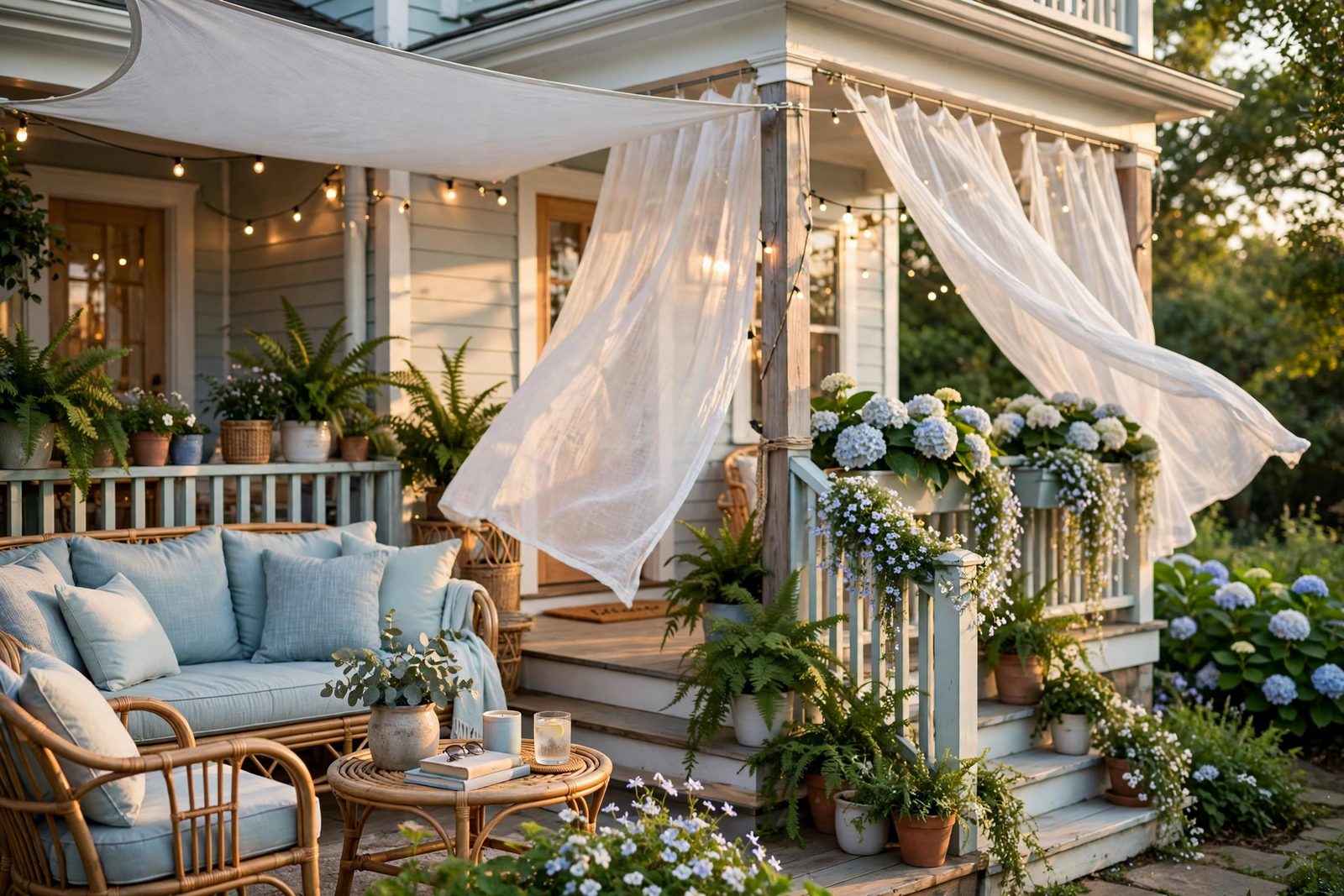
There is a specific kind of summer happiness that only happens on a porch: iced tea sweating on the armrest, a book face-down on your chest, the dog snoring under the rocking chair. These summer porch decor ideas are built around that feeling — not a showroom porch, but one you actually live on from June through September.
A summer porch asks for different things than a spring or fall porch. The enemy is heat, so shade and airflow come first; the reward is long evenings, so lighting comes second. Everything else — the cushions, the plants, the rug — should feel light, breathable, and cool to the eye. Heavy textures and dark colors go back inside until October.
The ten ideas below work on real porches: small stoops, rental railings you cannot drill into, and west-facing roasters that fry everything by four o'clock. Most cost little, none need a contractor, and a few will genuinely lower the temperature you feel out there.
What Gives a Porch That Instant Summer Feeling?
Summer reads as movement and air: things that flutter, dapple, and sway. A white curtain lifting in the breeze, dappled shade from a sail, and trailing plants all signal summer faster than any color scheme because they move with the weather. If your porch feels static, it will not feel summery no matter how many blue pillows you buy.
Start with the sensory trio: something overhead (shade or lights), something soft underfoot (a rug or clean boards), and something green within arm's reach. That combination tricks the brain into perceiving the porch as cooler — shaded, soft, alive — even before the temperature actually drops a degree.
Do the before-and-after test in one afternoon. Clear everything off the porch, then add back only the trio above. Sit down with a cold drink at three o'clock, the harshest hour, and notice the difference. Most people stop there and realize they needed less than they owned — summer decorating is mostly about removing the heavy winter layers.
How Do You Choose Breezy Outdoor Fabrics?
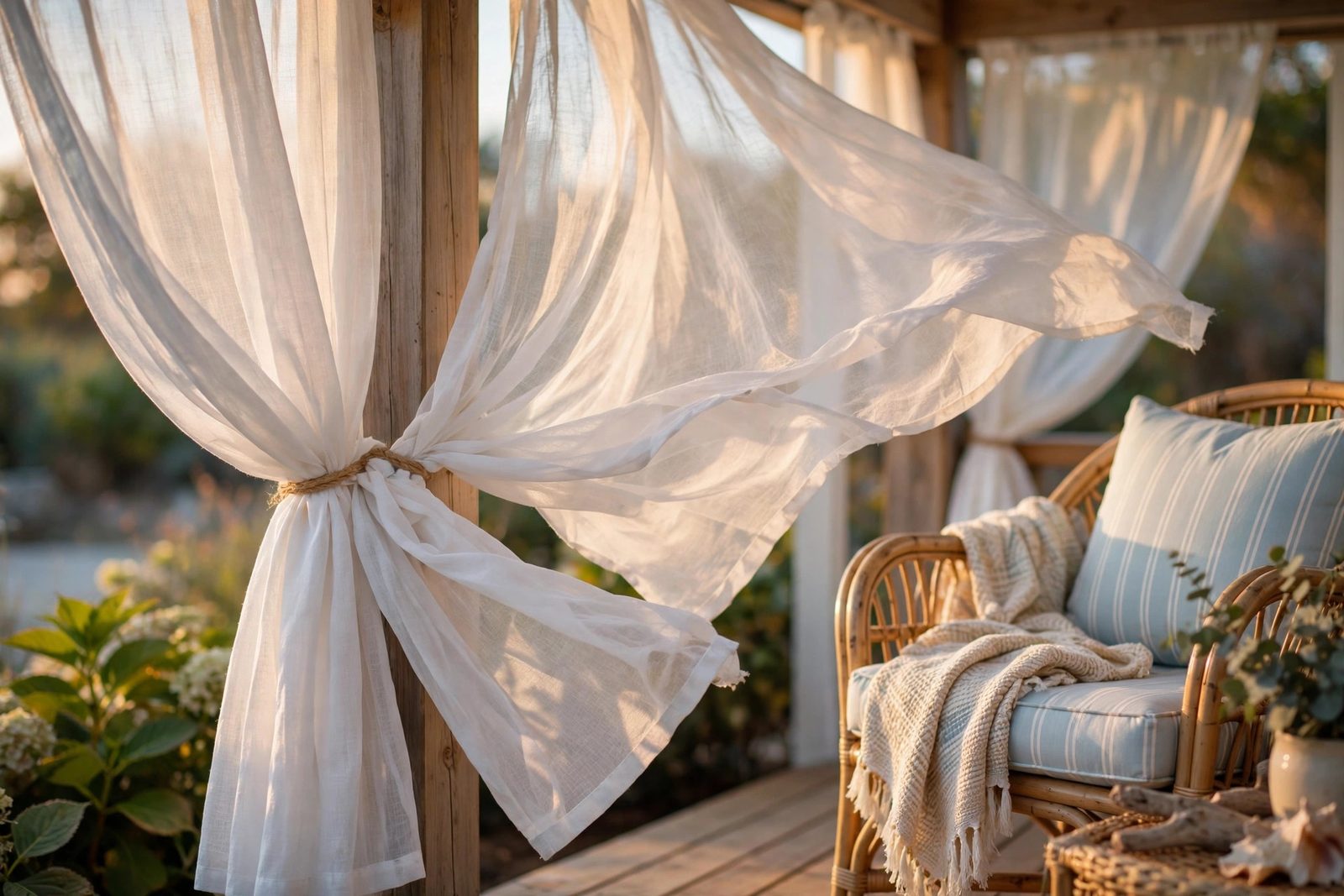
The fabric mistake most porches make in summer is keeping spring's heavy layers. Swap thick throws and velvet-look pillows for lightweight weaves: linen-look outdoor cushions, cotton gauze throws, and semi-sheer curtains that actually move. Sheers let you see the garden while filtering the glare, and they make the whole porch feel five degrees cooler just by existing.
For outdoor curtains, buy panels made for outdoors — polyester voile or HDPE mesh — and hang them from a tension rod or a wire cable between posts. Aim for panels at least twice the width of the span so they gather richly, and tie them back with rope or ribbon on calm days so the porch does not feel walled in. Washable panels survive pollen season with a monthly hose-down.
Go light in color as well as weight. White, ivory, and pale sand reflect heat and photograph beautifully at golden hour, while dark navy or charcoal fabrics absorb afternoon sun and make seating genuinely hot to the touch. Keep one washable light throw on every seat for chilly nights — summer evenings cool off fast, and a throw you can toss in the machine is the whole point.
What's the Best Way to Add Shade to a Sunny Porch?
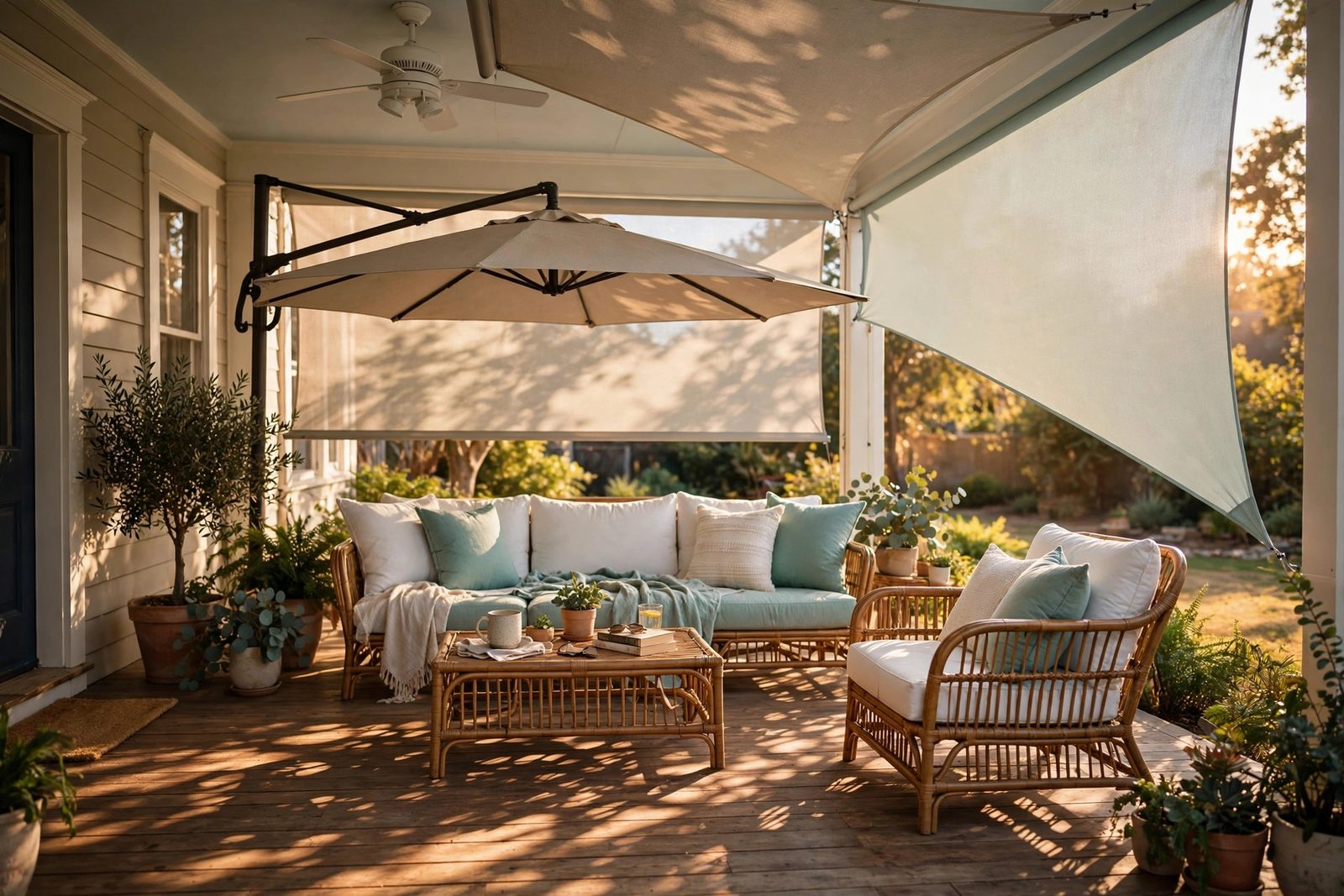
Shade is the highest-ROI move on a summer porch because it changes the temperature, not just the look. A covered seating area can feel ten to fifteen degrees cooler than the same porch in direct sun. If your porch faces west or south, shade is not decoration — it is the difference between using the porch and abandoning it until September.
For a budget-friendly fix, a cantilevered patio umbrella on a weighted base costs far less than a permanent structure and moves with the sun. Position the base on the sunny side and tilt the canopy as the afternoon progresses. A shade sail is the renter-friendly runner-up: one sail mounted on three tension points with removable hooks cuts glare over a seating corner and comes down in minutes before a storm.
Do not forget the porch ceiling itself. An outdoor-rated ceiling fan moves air down onto you and makes humidity feel manageable — on a still July evening it is the difference between pleasant and sticky. Run the fan counterclockwise to push air down, and mount it at least seven feet above the floor. If you cannot wire a fan, a tall oscillating outdoor fan in the corner of the seating area does honest work.
How Should You Light a Porch for Summer Evenings?
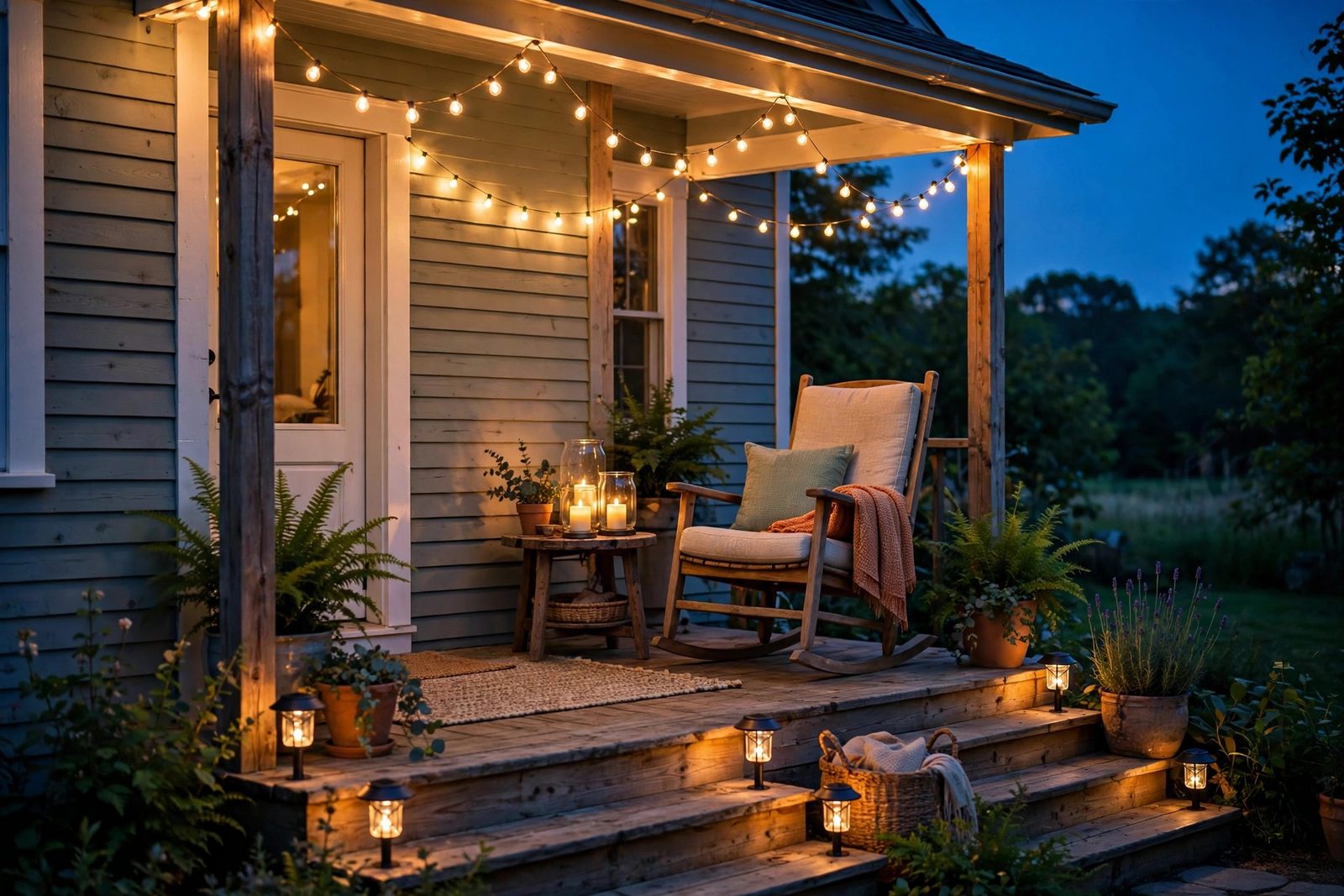
Summer evenings are the payoff of porch life, and warm low lighting is what keeps you out there after the sun drops. Skip the harsh overhead porch light — it flattens everything and draws every moth in the county. Instead, layer three kinds of glow: string lights overhead for ambiance, lanterns at seating level for task light, and small step or path lights for safety.
Hang string lights with a gentle swag — six to twelve inches of drop per span — from two solid anchor points, or zigzag them across a wide porch for a canopy of light. Warm-white LEDs (2700K) read as candlelight; anything labeled daylight or cool white will make the porch feel like a parking lot. Plug-in strands with a dusk-to-dawn timer are the most reliable, since solar strings dim out on cloudy days.
Keep candles flameless on a summer porch. Real flames plus a gusty evening plus curtains is a combination nobody needs. LED pillar candles in glass hurricanes give the same flicker with zero worry, and citronella-scented versions earn their keep in mosquito season. Line the steps with solar lanterns so the path glows whether or not anyone remembered to flip a switch.
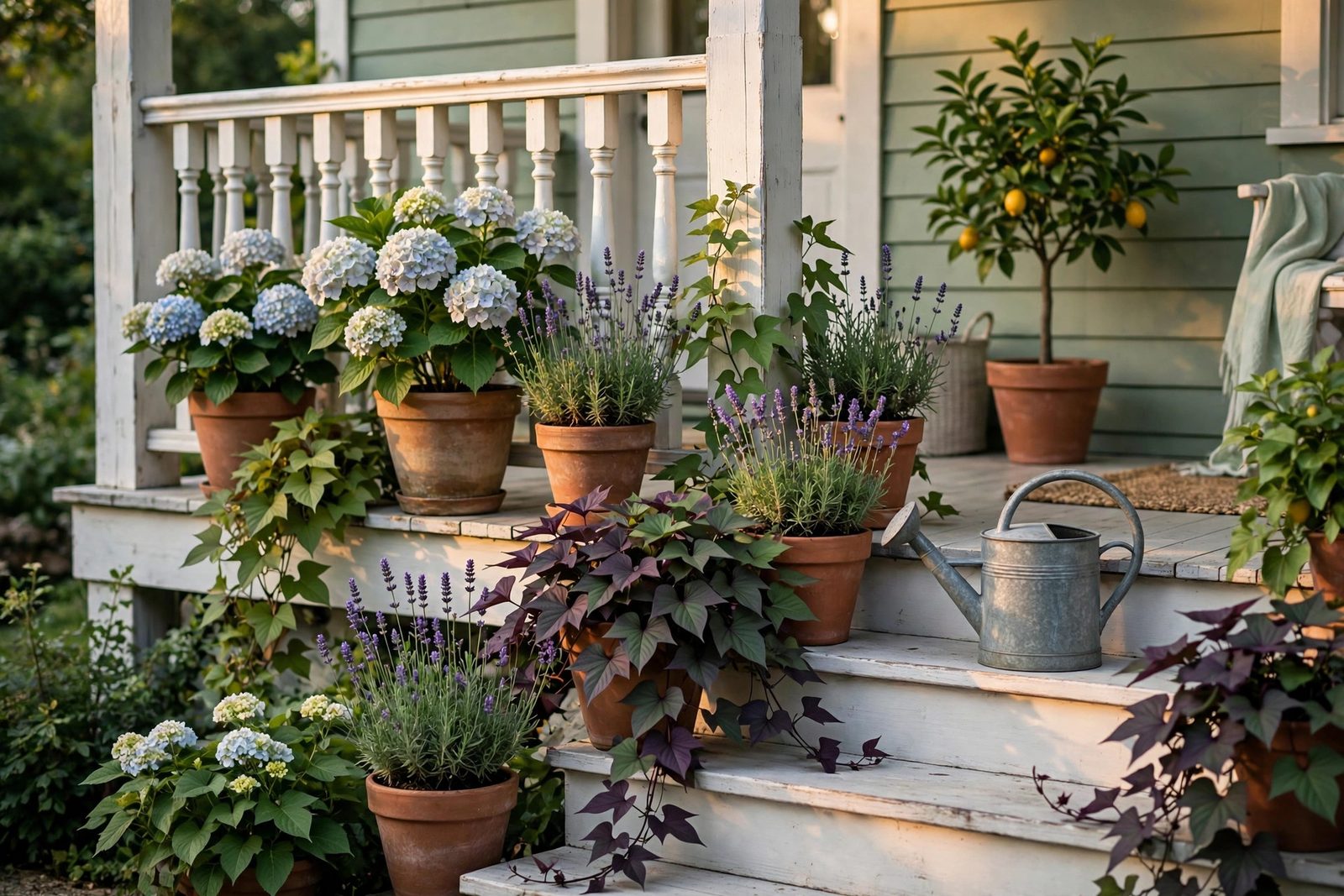
What Potted Plants Actually Survive a Hot Porch?
The classic summer-porch plant fail is buying shade-lovers for a sun-blasted stoop. Match plants to the heat: geraniums, lantana, sweet potato vine, and mandevilla laugh at ninety degrees, while lavender and rosemary handle sun plus neglect and smell wonderful when you brush past them. For shadier porches, hydrangeas and ferns thrive with just morning sun.
Layer your pots the way a florist builds an arrangement: a tall thriller in the back (a small lemon tree or a grass), a filler in the middle (lavender, geraniums), and a spiller at the front (sweet potato vine trailing over the rim). Group pots in odd numbers — three or five — and cluster them tight instead of spacing them evenly along the railing; clusters read as lush, scattered pots read as chores.
Heat means pots dry out fast, so size up. A fourteen-inch pot holds water far longer than a ten-inch one and needs watering once a day instead of twice. Self-watering reservoirs or a simple drip line on a hose timer remove the chore entirely. Mulch the tops of the pots with bark or cocoa shells to slow evaporation, and water in the early morning so leaves dry before the midday sun scorches them.
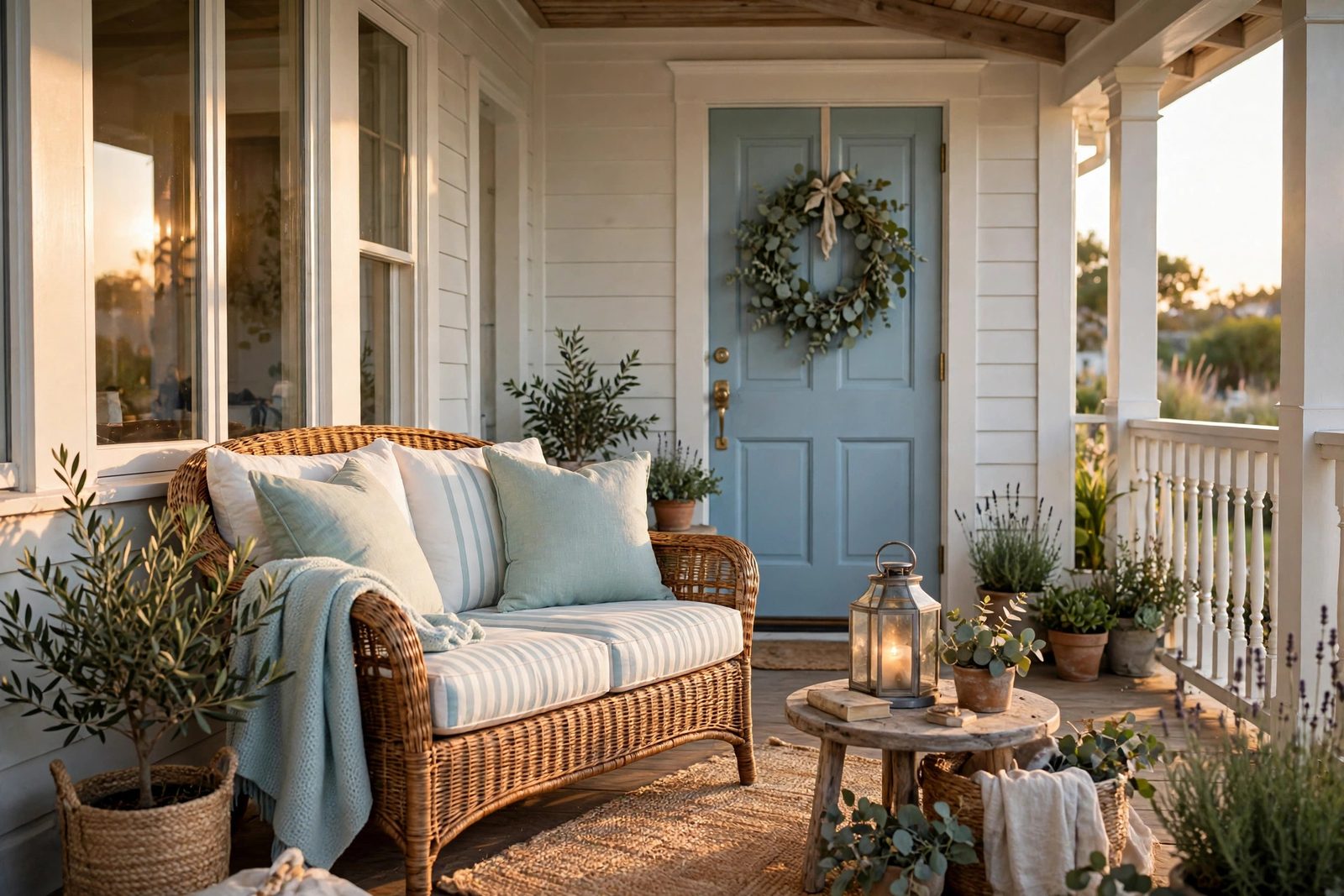
How Do You Build a Cool, Calming Color Palette?
Cool colors do real psychological work in summer: blues, seafoam, pale aqua, and crisp white make a porch feel breezy even when the air is still. The simplest formula is a neutral base (white, sand, natural rattan) plus one watery color repeated three times — cushions, a throw, and a door wreath, for example. Repetition is what makes a palette read as intentional rather than random.
Let the porch door do the heavy lifting. A front door in coastal blue, sage, or soft teal anchors the whole color story in one afternoon of painting and pairs with almost any cushion color. Then echo it lightly: a striped rug that picks up the door color, one painted pot, and maybe the ribbon on your wreath.
Keep the ratio heavily weighted to neutrals — about seventy percent white and natural tones to thirty percent color. Small doses of green come free from your plants, so you only need to buy blue and white. Avoid piling on brights: one sunny yellow accent (a pillow, a watering can) adds cheer, but three or four brights competing on a small porch just look busy.
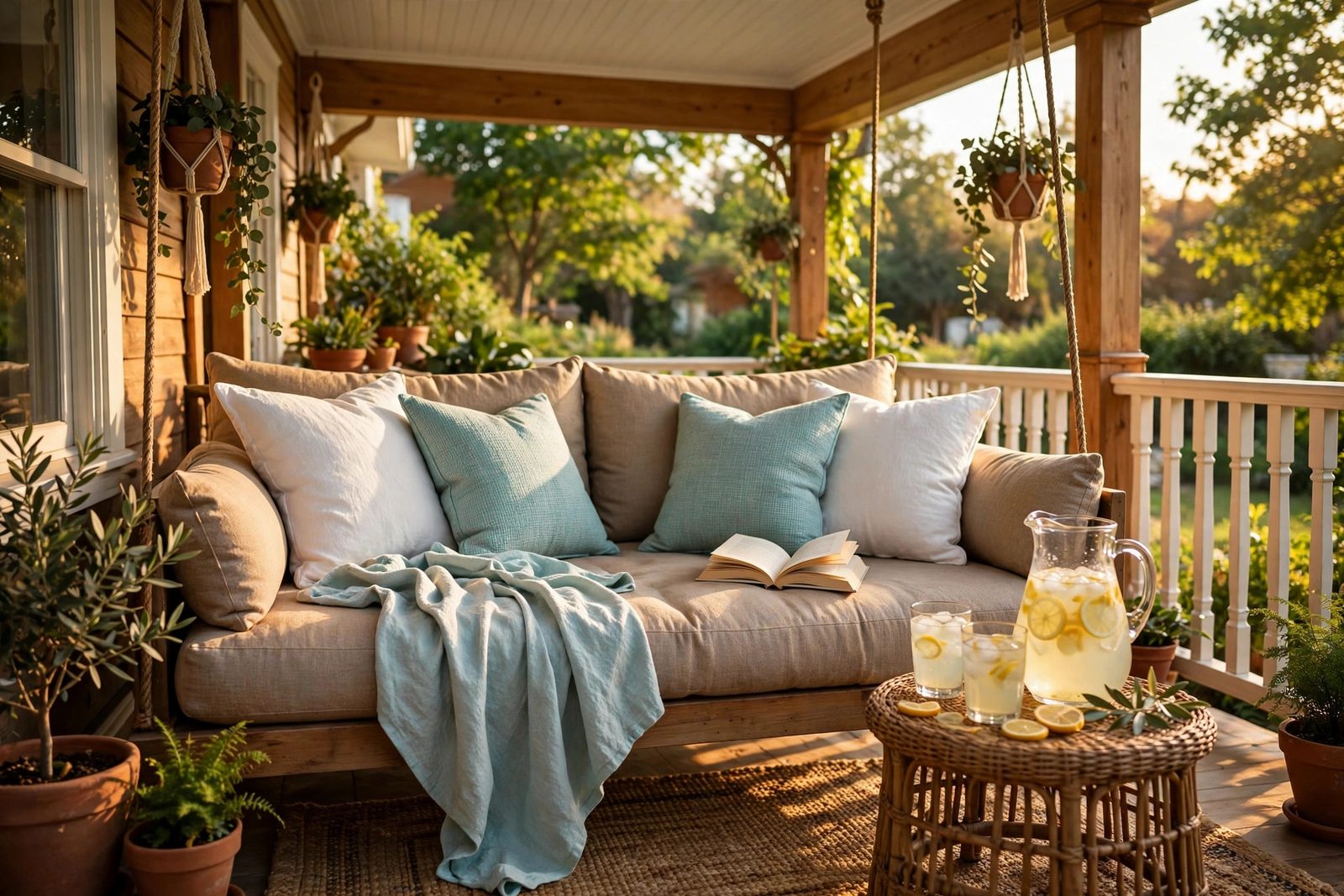
How Do You Create a Lounge-Worthy Porch Corner?
A porch corner earns its keep when you can lie down in it. A daybed swing or a wide porch swing with a mattress-depth cushion is the gold standard — gently rocking, deep enough for a nap, and the single piece of furniture guests fight over. If a swing is too much, a chaise lounge or an oversized papasan-style chair with a footstool gets you most of the way there.
Build the corner for the longest sits: deep cushions with outdoor-rated foam that does not flatten in a week, a small side table within arm's reach for drinks and a book, and a basket or deck box nearby holding the light throws for after sunset. Everything within a two-foot radius should serve lounging; anything else is clutter that will get knocked over.
Face the lounger toward the view you actually have, not the street. Angle it toward the garden, the sunset, or the quietest corner of the yard — porches that face the street still get used when the best seat looks past it. A pair of hanging planters at the edges frames the view and gives the corner a tucked-in, private feeling without blocking airflow.
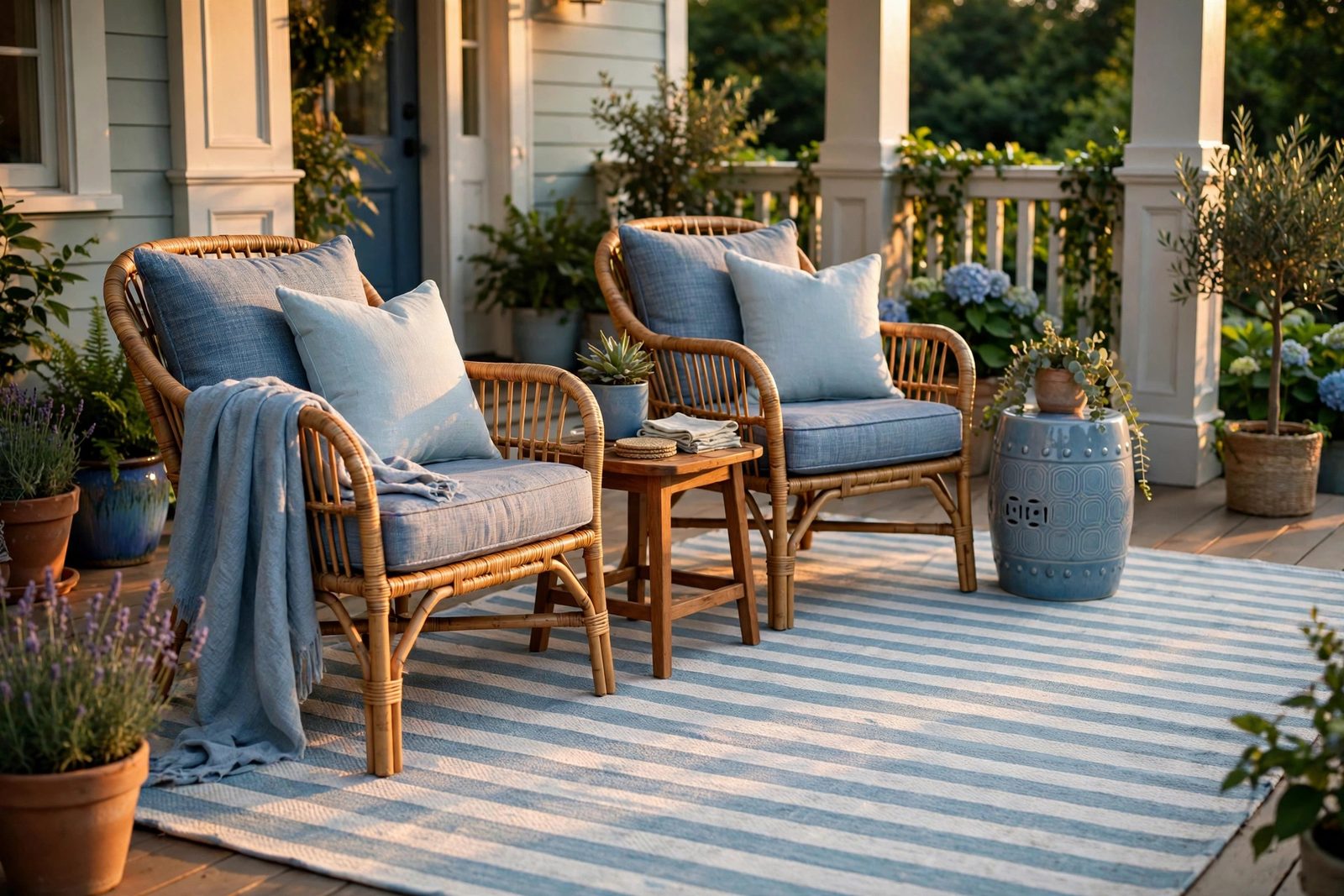
Do You Really Need an Outdoor Rug on a Porch?
Strictly speaking, no — but an outdoor rug does more work per dollar than almost anything else on this list. It defines the seating zone, softens hard boards or concrete under bare feet, and ties scattered furniture into one picture. A porch without a rug reads as a walkway; the same porch with one reads as a room.
Size it generously. All front legs of every seating piece should sit on the rug — for a typical chair pair and side table, a five-by-seven-foot rug is the minimum, and going up to eight-by-ten on a big porch never looks wrong. A too-small rug that chairs dangle off of makes the seating feel cramped and unstable.
Choose a flat-weave polypropylene or recycled-plastic rug made for outdoors; it hoses clean, dries in an hour, and resists mildew. Stripes and borders in blue-and-white or sand-and-natural hide summer dust and pollen far better than solid pale rugs. At season's end, roll it up, hose it off, and store it standing upright so it unrolls flat next June.

How Do You Set Up a Summer Refreshment Station?
A tiny drink station turns a porch from furniture into hospitality. You need only a small console table or sturdy stool in a shaded corner, a two-gallon glass dispenser with a spigot, a stack of tumblers, and a bowl of lemons and fresh mint. Fill it with lemonade, iced tea, or cucumber water on Saturday morning and the porch basically hosts itself all weekend.
Keep the setup heat-smart. Place the station in the shade — sun warms lemonade fast and fogs the dispenser — and put a tray or oilcloth under everything so condensation does not ruin the table. A bucket of ice beside the dispenser lasts longer than ice in the drinks, and guests love the ritual of clinking their own glass full.
Make it washable and closable. At night, bring the dispenser inside (fruit flies find porch sugar within an hour) and stash the tumblers in a lidded basket or deck box. The whole station packs away in five minutes, which means you will actually set it up again next weekend instead of dreading the cleanup.
What's the Cheapest Way to Refresh a Porch for Summer?
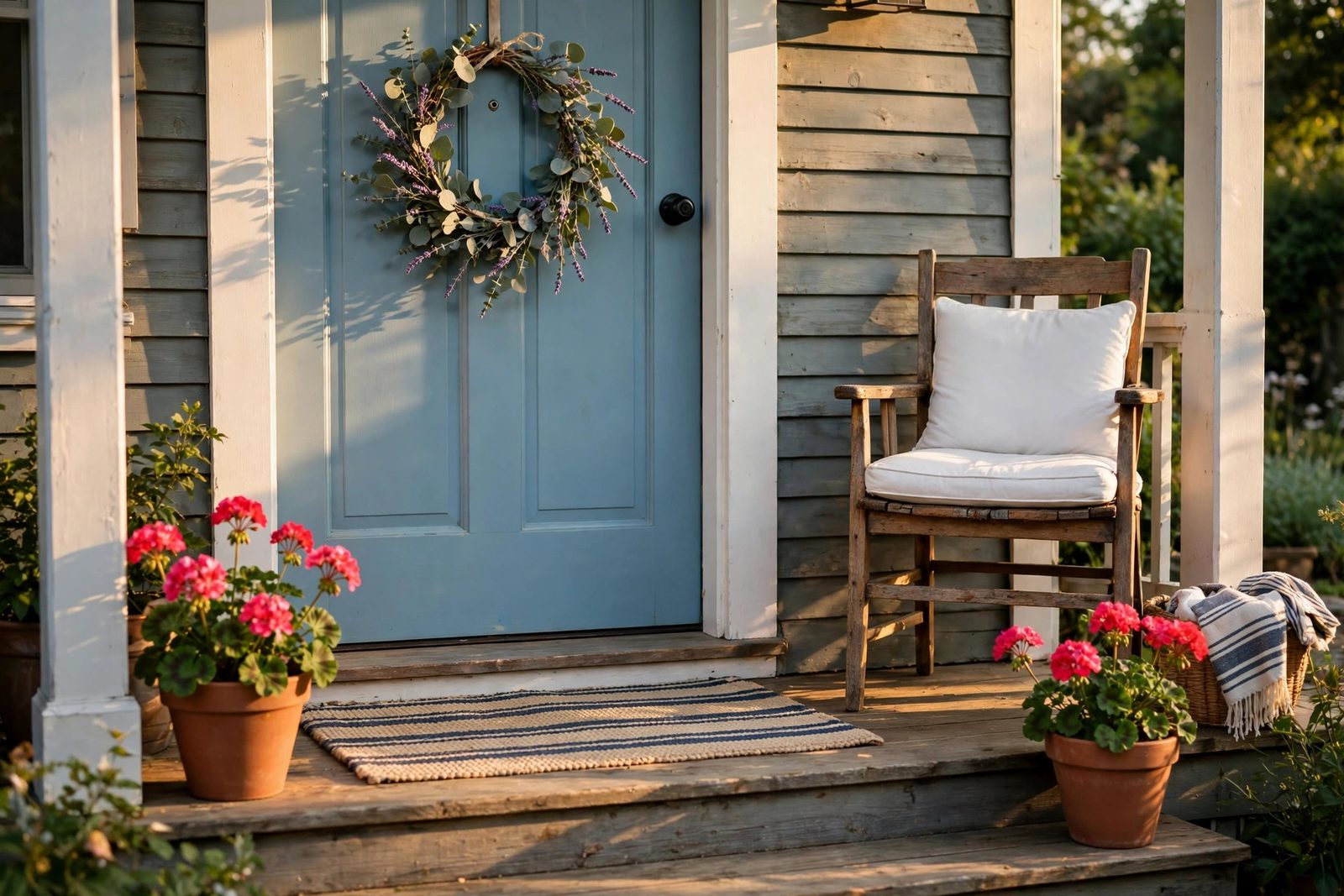
If the budget is tight, spend it at the door. A fresh doormat, a coat of paint on the front door, and one big healthy planter flanking each side of the steps change the whole first impression for under a hundred dollars. The door is where the eye lands; get it right and the rest of the porch can stay simple.
Go thrifty on everything that does not touch weather directly. A secondhand wooden chair with a fresh white cushion cover, a basket for rolled towels or throws, and a simple green wreath on the door all read expensive when the styling is clean. One coat of exterior paint on a tired door in coastal blue or sage takes an afternoon and transforms the house's face.
Finish with living color, not purchased decor. Two pots of geraniums or petunias in bloom cost less than one decorative sign and do a hundred times the work. Plant them in pots you already own, deadhead them weekly, and they will bloom hard until the first frost — the cheapest summer color there is.
Beating the Heat: A Cool-Comfort Checklist for Sun-Blasted Porches
If your porch faces west or south, decorating around the heat is more important than decorating around a style. Work through this checklist before you buy anything: identify the hottest hour (usually 3-5 PM), find the naturally coolest corner (often the end closest to the house wall), and place your best seating there instead of where it photographs best. Comfort beats composition in July.
Layer your defenses in this order: shade first (umbrella, sail, or fan), then airflow (fan direction, cleared sightlines for the breeze), then surfaces (light-colored rug and cushions instead of dark furniture that absorbs heat). Each layer multiplies the last. A shaded, breezy porch with a light rug is usable at four o'clock; a sunny one with dark cushions is not usable at all.
Protect the pieces too. UV is the summer porch's silent destroyer: bring cushions inside during multi-day heat waves when the UV index is extreme, and choose solution-dyed acrylic fabrics whose color goes all the way through the fiber instead of printed canvas that fades by August. A cheap furniture cover for the sunniest piece buys you an extra season or two of good looks.
The 30-Minute Weekly Summer Porch Reset
Summer porches get messy fast — pollen, dropped petals, condensation rings, dusty cushions — so build a tiny weekly rhythm instead of a big monthly deep clean. Once a week, sweep the floor and shake out the rug (five minutes), wipe down the table and chair arms with a damp cloth (five minutes), and deadhead the pots and pinch back anything leggy (ten minutes).
Every other week, hose down the rug and the curtains and let them dry in the sun, and check your light strands and solar lanterns — summer storms loosen hooks and a dead string light at dusk is a small sadness you can prevent. Refill the citronella candles and top up the drink station supplies so the porch is always guest-ready.
The ten minutes nobody thinks of: walk the porch at night once a month and look at it from the street. Burned-out bulbs, a sagging curtain tie-back, and a plant that quietly died in the back corner are invisible at noon and obvious at eight. A porch you enjoy after dark stays decorated longer, because you notice problems while they are still small.
Final thoughts
The best summer porch is not the most styled one — it is the one you sit on every day. Start with shade and airflow so the space is actually usable in the heat, add the rug and the lights so it feels like a room after dark, and let the plants and the breezy fabrics do the rest. One good weekend gets you eighty percent of the way there.
Then live on it before you buy more. A week of mornings with coffee and evenings with the string lights will tell you exactly what is missing — maybe it is the side table for your book, maybe it is the fan for the still evenings. Decorate for the life you already have out there, and the porch will take care of the lazy days by itself.
FAQ
How do you keep a summer porch cool without air conditioning?
Shade is the biggest lever: an umbrella, shade sail, or covered roof can drop the felt temperature by ten degrees or more. Add an outdoor ceiling fan or tall oscillating fan for airflow, choose light-colored fabrics that reflect heat instead of absorbing it, and hose down a hot concrete or stone porch in the late afternoon — the evaporative cooling lasts for hours.
What are the best heat-tolerant plants for a sunny porch?
Geraniums, lantana, mandevilla, sweet potato vine, and zinnias thrive in full summer sun and heat. Lavender and rosemary handle sun plus irregular watering and add fragrance. For foliage, try croton or coleus in shaded corners. Use large pots (14 inches or more) so soil stays moist longer, and mulch the tops to slow evaporation.
Can I hang outdoor curtains on a rental porch?
Yes — use tension rods inside the porch frame or wire cable with removable adhesive or clamp-style hooks on the posts, so nothing gets drilled. Choose outdoor-rated semi-sheer panels that survive weather, and tie them back on windy days to avoid damage. Take them down before major storms and wash them monthly to keep pollen from dulling them.
How do I keep mosquitoes away from my porch in summer?
Start with airflow: a ceiling fan or strong oscillating fan physically disrupts mosquitoes' flight. Remove standing water from saucers and plant trays weekly, since that is where they breed. Layer citronella candles or a diffuser with the fan, and plant lavender, basil, and mint near seating — they smell great to you and help mask you from mosquitoes.
What size outdoor rug should I get for a porch?
Big enough that all front legs of your seating sit on it — a five-by-seven-foot rug is the minimum for a chair pair and side table, and eight-by-ten suits a full lounge set. A too-small rug makes the seating look cramped. Choose a flat-weave outdoor-rated rug in a stripe or border pattern, which hides dust and pollen better than solid colors.
How do I decorate a summer porch on a budget?
Spend where the eye lands: a fresh doormat, a painted front door, and two big blooming planters at the steps change everything for under a hundred dollars. Go secondhand for furniture and add washable light cushions, then let living plants supply the color. Skip purchased signs and knick-knacks — greenery and good lighting do more work for less money.